Helen, Queen of the Nautch Girls
Maurice
The traditional bildungsroman, or novel of education, ends with a marriage. E.M. Forster's Maurice(1914), the second of his novels to be adapted by Merchant Ivory, takes on a subject that no major novel in the genre had ever addressed: the problem of coming of age as a homosexual in a restrictive society. First published in 1971, after Forster's death, and long neglected by critics, it is only recently (and largely since the release of the film adaptation) that critics have come to set Mauricein its unique place among "Reader, I married him" narratives.Starring James Wilby (Maurice) and Hugh Grant (Clive) as two Cambridge undergraduates who fall in love, the film is set amidst the hypocritical homoerotic subculture of the English university in Forster's time. In an environment in which any reference to " the unspeakable vice of the Greeks" is omitted, and any overture toward a physical relationship between men might be punishable by law, Maurice and Clive struggle to come to terms with their own feelings toward each other and toward a repressive society.
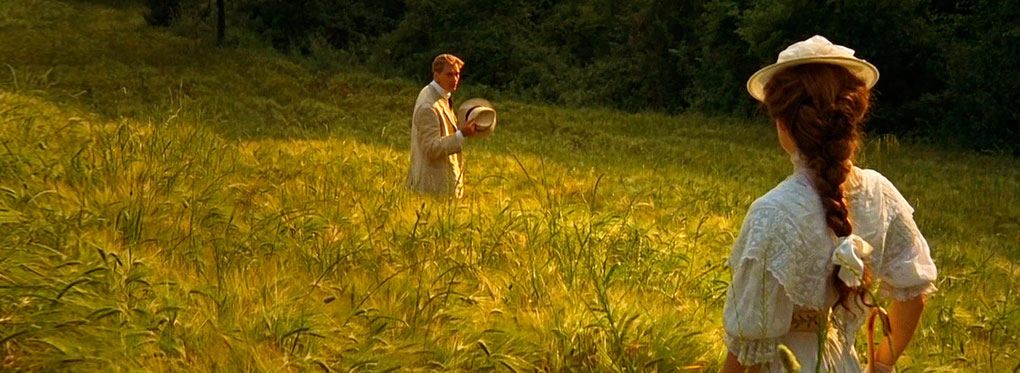
Maurice was shot on location largely in the halls and quadrangles of King's College, Cambridge (including stunning interiors in the college's world famous Gothic chapel), where Forster was educated and later returned as a Fellow. The other interiors were primarily shot at Wilbury Park, an early Palladian house in Wilshire. Called Pendersleigh in the film, this setting is where Maurice visits his friend Clive; here he later meets the under-gamekeeper Alec Scudder (Rupert Graves), who climbs in his window one night in order to "share" with Maurice, as the genteel Edwardians put it. Wilbury Park was a warm-up for Ivory for the grand country house scenes in The Remains of the Day, shot six years later.
Wilby, under Ivory's direction, infuses the title character with a quiet sensitivity and an underlying sense of desperation to create a character who, as Forster wrote, has "an ingredient that puzzles him, wakes him up, torments him and finally saves him." Grant plays Clive with a blend of dead-on English public school arrogance and intimate vulnerability that attracts, and then nearly destroys, Maurice.
Mark Tandy is the confident Cantabridgian Lord Risley, whose later conviction as a criminal "of the Oscar Wilde sort" changes the course of the film. Denholm Elliot, Simon Callow, and Ben Kingsley turn in strong performances as alternately well meaning and judgmental men who try and guide Maurice into a conventional married life.
The film had its world premiere at the Venice Film Festival in 1987, where Ivory was awarded a Silver Lion as Best Director, sharing the prize with Ermanno Olmi. James Wilby and Hugh Grant were jointly awarded Best Actor, and Richard Robbins received the prize for his music -- a subtle and richly atmospheric score that is one the most memorable features of Maurice.
News
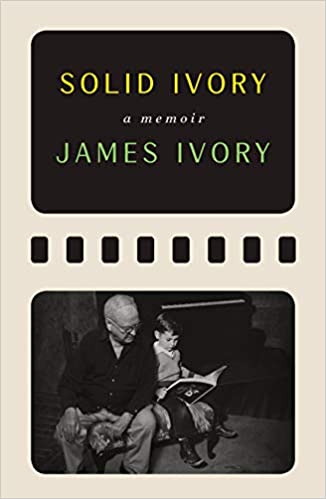
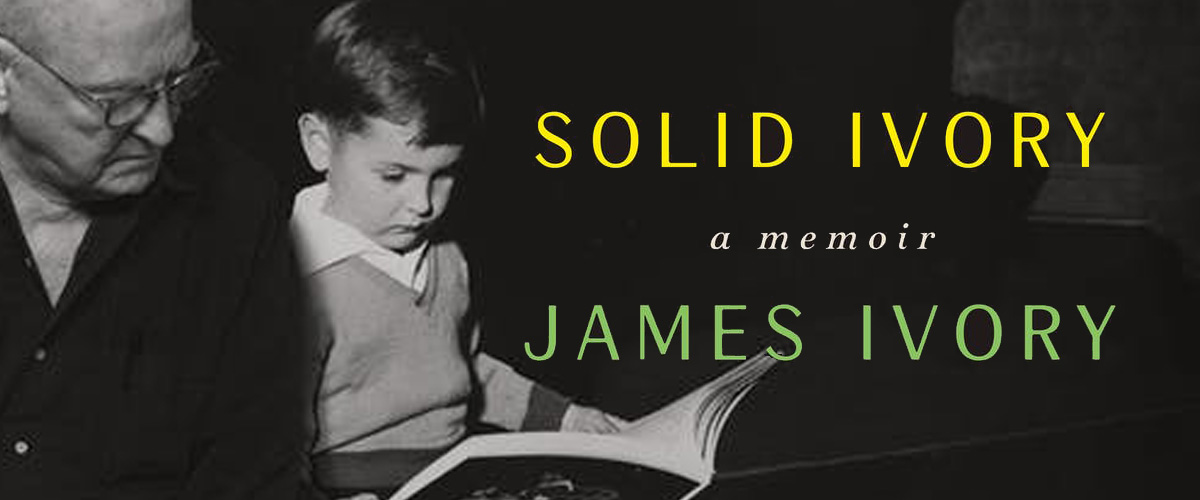
Solid Ivory: A Memoir
by James Ivory (Author), Peter Cameron (Editor)
In Solid Ivory, a carefully crafted mosaic of memories, portraits, and reflections, the Academy Award–winning filmmaker James Ivory, a partner in the legendary Merchant Ivory Productions and the director of A Room with a View, Howards End, ...Bombay Talkie
Lucia Lane (Jennifer Kendal), an English novelist, comes to Bombay to research the Bollywood film scene for a book she is planning to write. She is introduced by a producer (none other than Ismail Merchant) to the dashing movie star Vikram (Shashi Kapoor) and the screenwriter Hari (Zia Mohyeddin). Vikram, who is married to the beautiful but barren young Mala (Aparna Sen), falls in love with Lucia and they begin an affair, evoking a fierce rivalry between Vikram and Hari, and a painful envy on the part of Vikram's wife. Lucia, seeking escape and enlightenment, flees to a guru (Pincho Kapoor) but cannot bring herself to abandon her worldly desires for a subservient life in the ashram. She returns to Vikram and the various love triangles collapse, bringing the characters to desperation and the entanglement to a startling resolution.
Shot entirely on location in and around the city of its title, Bombay Talkie is one of Merchant Ivory's most distinctive films, at once a psychological drama and a parodic hommage to the Indian film scene of the late 1960s and early 1970s.
The eclectic dramatis personae include Uptal Dutt as Bose, a corrupt producer, Nadira as Anjana Devi, Vikram's confidante, and a full complement of women who enact a musical number on a giant typewriter (one of Ivory's favorite film sets to date), as the dancers' movements type out Fate ("It's very symbolic," Lucia compliments). Subatra Mitra, the master cameraman of Satyajit Ray, provides the photography, and it is to great effect that his unassuming lens is set upon the director's shrewdly observed scenes. At one moment in the film, an elderly Indian fan of Lucia's novel Consenting Adults arrives at her hotel to ask her for an autograph: as Lucia flees and the absurd exchange is played out, the camera pulls back and patiently watches the two descend the grand staircase of the Taj Mahal Hotel. It is one of the film's many moments in which the comedy of a situation is made more acute by the lyricism of the visuals.
 |
Jennifer Kendal is magnificent as Lucia: her offhand candor and genuine sweetness make her all the more believable as a homewrecker who doesn't seem to grasp the consequences of her actions. She moves effortlessly from quiet despair, a middle-aged woman alone in a foreign hotel, to fish-out-of-water scenes at an ashram which put one in mind of Maria von Trapp in the convent, dreaming of the hills and the Captain. Shashi Kapoor brings to Vikram that star quality which attracts the legions of adoring women who seem always to surround him; and Aparna Sen paints a quietly affecting Mala. Like the goddess Devi, whose image appears on screen, Sen's Mala is part long-suffering wife, part Fury.
From the opening credits sequence (probably the most original of any Merchant Ivory film) to the films within the film (the musical, the Indian western), Bombay Talkie claims a unique place in Ivory's work for its elements of meta-film -- a film about film, in which the viewer is at once involved in what is on-screen and aware of the medium. Yet there are also those familiar elements of uprooted persons and cultural difference that characterize both the earliest and the most recent films of Merchant Ivory. Lucia, late in Bombay Talkie, tries on one of Mala's saris and Vikram explains to the uninformed Englishwoman that it is his wife's wedding sari. Just then, Mala enters to see her husband's lover dressed in her own wedding clothes: as in many of Merchant and Ivory's films, cultural misunderstanding leads to human drama of the most visceral and affecting kind.
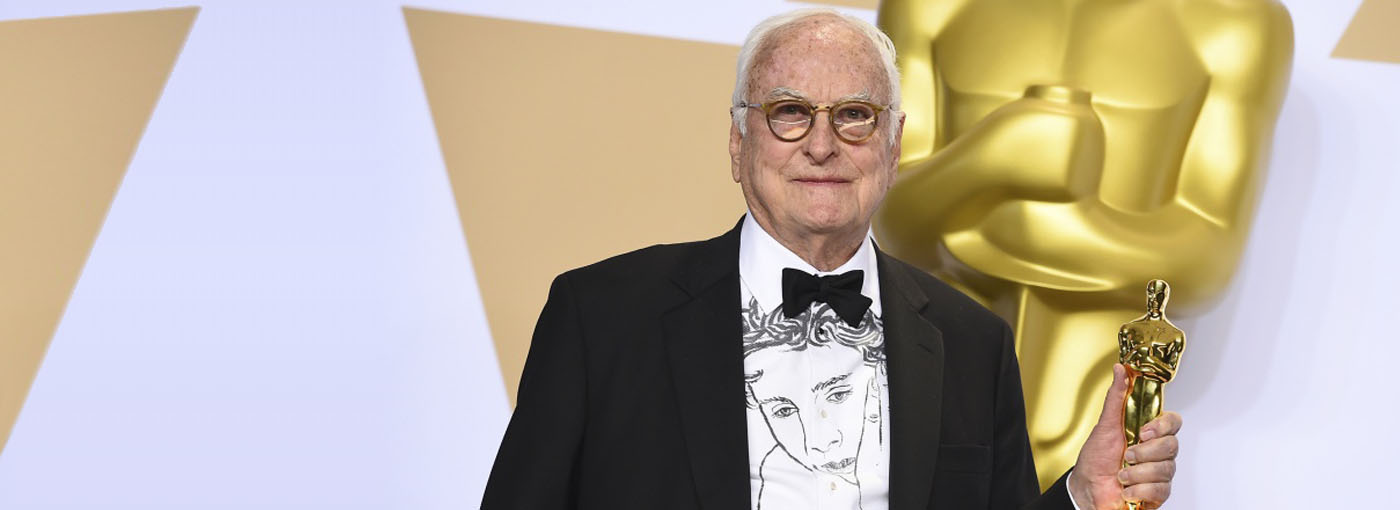
James Ivory Takes Home the Oscar for Best Adapted Screenplay
Social
Subscribe now and stay up to date
Stay up to date on new releases and re-releases of your favorites