|
"It
works diagonally": A Conversation with Ruth Prawer
Jhabvala
on The Golden Bowl and the Art of Adaptation
by Philip Horne
Ruth
Prawer Jhabvala is a novelist and screenwriter whose work
with Merchant Ivory includes screenplays for A Room
with a View, Howards End, The Remains of the Day,
and Heat and Dust. Jhabvala has won a Booker Prize,
two Oscars, and is a MacArthur Fellow. Her most recent
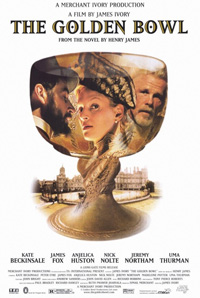
work is an adaptation of Henry James's The Golden Bowl,
her third Henry James adaptation for the Merchant Ivory
company.
Academic
and author Philip Horne spoke with Ruth Prawer Jhabvala
in an interview for London's Guardian newspaper.
The following are exceprts from their conversation.
After
escaping from Nazi Germany you came to London in 1939,
and later studied English at London University. Does Anglo-American
literature have a special meaning for you?
RPJ:
I was very lucky to go to England when I did. I was also
very lucky to have the years of doing nothing but reading,
mostly English literature. So my whole background is that.
It was extremely fortunate for me. Also English became
my first language.
Do
you think studying literature is a better preparation
for writing screenplays than going to film school would
be?
RPJ:
Well, I started off and still am primarily a novelist,
and not a screenwriter. Studying English literature is
really not studying - to have all those years to read
is a gift. Particularly as I wasn't really good at anything.
While I was preparing for my degree, I never wrote. I
wrote before and after, but during those years I just
read. I even did a thesis on the short story in England
from 1700-1750. There weren't any of course - but that
was my thesis.
Do
you think that studying literature at university is why
you were interested in adapting classics?
RPJ:
I was never interested in adapting classics at all. I'd
written four novels. I was never interested in film. Never.
I never even thought of it. I never thought of it until
Merchant Ivory came to India and filmed one of my books
- they said: "Why don't you write the screenplay?" I said
I'd never written a screenplay and I hadn't seen many
films because I was in India by that time and hadn't really
had any opportunity to see new films or art films or classic
films or anything. So they said, "Well, try. We haven't
made a feature film before." So that was really my introduction
into film.
Is
there a main purpose in adapting classics for film?
RPJ:
The main purpose is that I have such a good time. I mean,
think of all that marvelous material. Just think of spending
all that time in The Golden Bowl and the other
James and Forster books we have done. But especially Henry
James because he has such marvelous characters and he
has such strong dramatic scenes. You just put your hand
in and pull them out.
There
isn't an educational impulse?
RPJ:
I'm afraid not! Maybe there should be, but I'm afraid
I only think of myself.
I
suppose you are trying to communicate your enjoyment.
RPJ:
Yes, yes. I suppose, yes. And in a way it's a homage to
a great author. You know I never write any critical articles
or critical reviews, never write anything except fiction
and screenplays, so it is a kind of homage. But I never
think I'm doing a public service or anything...
Do
you have any idea why American classics from the turn
of the century seem to be so fashionable now?
RPJ:
Is Henry James particularly fashionable?
In
the last few years...
RPJ:
Yes. Well, it is such grand material, wonderful scenes,
great characters, such wonderful relationships between
the characters - well, the material is there.
The
French director Jacques Rivette said in 1974 that James
is one of the "unfilmable" authors, who "can be filmed
diagonally, taking up their themes, but never literally."
You obviously don't agree...
RPJ:
No, I do agree! Any adaptation you do it diagonally. You
can take up the theme but you can never, never, never
do it literally. You'd come up with a kind of travesty,
if you tried to interpret anything literally.
But
fidelity, is that important?
RPJ:
Fidelity is not the first [thing]. No I don't think so.
Like I said, the theme and the feel of the characters...
the ambience and their relationships... that is what you
try...but never, never literally.
So
it's a separate work, really?
RPJ:
In a way. I'll tell you what I usually do. I read the
book several times, usually it's a book I know very well
anyway, but I read it several times and make some notes
and make a kind of plan that I think I would want to follow
- usually I don't, it breaks down at some point - and
then I put the book away and really don't look at it again
until I've filled out my own thing. And then I look at
it again and see what I have missed. But there is a period
when the book and I are two separate entities.
How
much changing do you do when you go back to the book at
that stage? Or what kinds of things do you change?
RPJ:
Nothing really - usually I find that I look for some poignancy
or some scene that might contribute more, that might point
something out that should be there in the screenplay.
I try and find that. Or even just half a line of dialogue
can be a Godsend to me at that point.
How
well do you find Henry James' dialogue works?
RPJ:
Well, again, it works diagonally. You really have to transcribe
it. He's not the only author - all the others - you can
never just take it off the page. However colloquial the
language might sound, this is not how actors can speak.
Could
I ask what you liked or what you didn't like about any
of the recent James adaptations?
RPJ:
Well, I like Portrait of a Lady very much, and
that was a book we had wanted to do over 20 years ago,
but we never had the money for it. We did two other Jameses.
We started with The Europeans because that was
all in America; it was much easier and a much smaller
film so it was much easier to raise the money. And then
again with The Bostonians, that was all in America,
easier for us to shoot. Then other things came in-between
and Portrait of a Lady went I'm afraid.
Did
you ever get as far as a script?
RPJ:
No.
Was
it hard work getting The Golden Bowl made?
RPJ:
To get it made? Um, well, some of the financiers said,
"This is not one of Henry James' really good novels."
They didn't want to go ahead with it. But we did get money
for the screenplay, money for the development, and once
we had that we didn't have too much difficulty.
How
did you pitch the story?
RPJ:
I wrote a sort of outline of the book - how we were going
to see it and a background of the characters - and that's
what we sent out. Because I didn't really expect anyone
to have read the book.
Was
there an emphasis that you thought was central to that?
RPJ:
Well, yes, I think that we said that this was a passionate
encounter between four people, and we thought that might
sound good to potential financiers. If this had been our
first, second or third film we may have had more difficulty,
but we did have a good [track] record, so people came
forward and said, "Well, it may not look like much, but,
you know... " [laughs]
How
different is The Golden Bowl to how you would have
done it, say, straight after The Europeans?
RPJ:
I don't think it would have worked so well for me. No,
I think I needed a lot more practice, because this was
a very difficult script. This was the hardest. This was
the nicest and the hardest. The only other one that has
been equally difficult and equally rewarding was Mr.
and Mrs. Bridge - I don't know if you know that one,
by Evan S. Connell - it was two books actually, which
we adapted into one. And that was one of my favourite
films. Those two were the hardest.
You
obviously have a wonderful working relationship with James
Ivory. But late Henry James is notoriously ambiguous and
difficult, and no two readers of The Golden Bowl
read it quite the same way - in fact, a single reader
often sees different things in it at each reading. Did
you always see it the same way?
RPJ:
I think we must have done. I mean the screenplay - he
read it, and he had some objections, but there was nothing
fundamental. I don't think we ever had a fundamental difference
of opinion.
Could
you talk about how your process of collaboration with
James Ivory works?
RPJ:
Well, when I lived in India and he lived in New York,
or wherever he was, we did a lot through correspondence.
But now we all live in New York... I am still so used
to working on my own that I do several drafts for myself
first and then send them to him to make marks in the margin.
And then I rewrite, and this goes on over a few months.
And then finally we sit together and see where we still
might have disagreements. Then he goes and shoots the
film - I have nothing to do with that - I only go along
to see some rushes. But I will see the rough cut, which
is usually twice the length of the final version, then
I see it again, and we sit in the editing room for some
time and, you know, fiddle about.
So
you are involved in the editing?
RPJ:
Yes, I am involved in the editing but not in the actual
production, or in the casting.
Whose
idea was it to begin the film in Renaissance Italy with
the discovery of adultery and the killing of the lovers?
RPJ:
I put that in right from the beginning because I thought
to myself, well how am I going to show who this prince
is and where he comes from? So I read a lot of books about
the Renaissance and I came across a story in which a duke
actually does kill a stepmother who was involved with
her stepson. I thought, well that's a good background
for this film.
The
duke is one of the ancestors?
RPJ:
Yes. And then there is the slideshow [later in the film],
of the families, and then the story of the duke is told.
Later
on, in your story, the role of the duke seems to be closer
to Adam Verver.
RPJ:
Well yes, you know, you're supposed to think that! In
the book, the figure of Adam Verver is ambiguous to the
end, so that we don't ever really know whether he has
any clear idea what's been going on, or whether he's a
bit of a simple soul, all of whose subtlety is used solely
on his business.
In
your film it seems to me we know very clearly that he
knows [what's going on between his wife and stepson].
RPJ:
He's immensely clever. A
man doesn't become a billionaire and a patron of the arts
if he's dim!
So
that ambiguity...
RPJ:
There is no ambiguity. How could he have become a billionaire?
In the book he manipulates the entire situation - he and
Maggie between them. He in silence, but he knew what everyone
else was thinking.
I
was struck by the sympathy with which you presented the
predicament of the Ververs who, in much academic criticism
since FR Leavis, are taken to be capitalistic vampires,
an essentially incestuous father-daughter team, draining
the passionate blood from their weaker partners. Do
you think there's a sinister side to what the Ververs
do in the book that doesn't appear in the film?
RPJ:
Not at all. I think Henry James loved Maggie Verver. He
loves her and he enters into her more than any other character
in any other novel. All of the passion that she has for
the prince, this is Henry James' passion that he has given
her. Though I like Gore Vidal's introduction [to the Penguin
edition*] very much, I didn't really like his thesis that
they are the manipulators, and the prince and Charlotte
are the victims. In a way they are the victims because
they are social victims, because they have nothing and
are dependent on father and daughter. But that has nothing
to do with the character of the Ververs, who are all goodness,
and Henry James painted them as goodness, in a way that
an earlier Bostonian knows goodness, I think.
I
admired your courage in actually having the golden bowl
itself appear and also be discussed as a symbol. Could
you say something about what it means for you?
RPJ:
Well first of all it's an object, we had to have it there,
it's a physical object, which one person buys and another
does not. The moment when the golden bowl is delivered
in the film is also the moment when she [Maggie] discovers
about the relationship between Charlotte and her husband.
The golden bowl itself - Fanny says she does not believe
it - it has a crack, it's damaged, and Fanny says, 'Who
would think? It looks so perfect?' And then she [Maggie]
says 'yes, a perfect fake'. And that's how she sees the
situation that has been created for her: her marriage
and her father's marriage are, in fact, perfect fakes.
Like the golden bowl. And shortly afterwards [Amerigo]
asks, well, 'What do you want?' and she says, 'I want
a happiness without a hole in it, I want the bowl without
a crack'. So it's a perfect symbol for us, and in the
film we do see it.
You
also seemed to have rethought Prince Amerigo, making him
less languid and passive than he appears in the book.
I noticed that he drives his own car and has his chauffeur
sit in the back; and he even wins a bicycle race. What
is the logic behind that?
RPJ:
Well, you can't have a languid central character otherwise
why would these two women be in love with him? You need
some kind of driving force.
In
the first edition of The Portrait of a Lady, Isabel
first comes across Mme. Merle playing Beethoven on the
piano; in the revised edition it's Schubert, a more beautiful,
sadder, less stirringly courageous composer. You have
Charlotte play Adam Verver a Debussy Sarabande. Does that
characterise her? [In the novel she just plays Adam some
of his 'favourite things', unnamed (182).]
RPJ:
No, not at all. Charlotte plays very badly and Henry James
says she plays as you would play a game of tennis, you
know, correctly but not particularly well.
Incidentally,
you have Fanny near the end of the film tell the story
of The Portrait of a Lady as if it's something
that's happened to a friend - she's a friend of Isabel
Osmond, nee Archer...
RPJ:
You spotted that? Good! In fact I put it right in, and
then she turns round and says, 'That dreadful husband,
what was his name?' I had in fact put in his real name,
but Jim [Ivory] thought that was going too far... so he
used another name.
Was
that a joke?
RPJ:
Well, I thought it was as good a story as any!
So
that's 20 years after the action of Portrait of a Lady?
RPJ:
Yes.
Do
you think Isabel is happy?
RPJ:
No, no. I'm afraid not [laughs]. I think this is the one
book with a happy ending.
Is
there a literary critic on The Golden Bowl whose
work you admire or agree with, or have been influenced
by?
RPJ:
No, I never read about anything, I always read the thing.
I read around the social life and where it all came from,
but it would disturb me to read other people's opinions
I think. I really want to go to the text itself, or to
how the text came about - the personal and social circumstances
behind it.
Do
you have any other James adaptations in mind?
RPJ:
No, I don't think so. I think that The Golden Bowl
is the ultimate for him, it's his last novel... so I don't
think I'd particularly want to. There's none that I could
think of now that I would want to do.
|