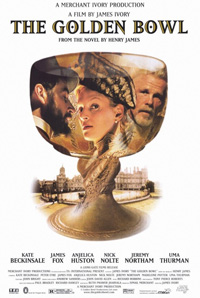
MERCHANT IVORY'S THE GOLDEN BOWL
A new production stars some of England's greatest houses

written by Mitchell Owens
photographs by Erica Lennard

The Golden Bowl was not ismail Merchant and James Ivory's first choice when it came to selecting another of Henry James's works to transform into a sweeping costume drama, their thirty-ninth film since the partners joined forces with novelist and screenwriter Ruth Prawer Jhabvala in 1961. Director Jane Campion beat them to The Portrait of a Lady, which was a personal dissapointment for Ivory, since Glenn Close had already signed on to costar as the tortured-by-love Mme Merle. "Then Ismail and I decided that we'd both like to go back to Venice," Ivory recounts, but The Wings of the Dove, set in that soggy, romantic city, was prempted as well.

So it was back to the bookself. The Ambassadors, says Ivory, "didn't have such a dramatic story to tell." That left The Golden Bowl, written in 1904 and generally considered the author's most difficult novel.

"It's an interior kind of book, a challenge to film with a wonderful story," says Ivory. "Ruth wanted to try to adapt it, so I said to go ahead." Another attraction was that The Golden Bowl, a complicated tale about two pairs of lovers - intertwined by marriage and desire and nearly destroyed by the revelation of a liaisonÆÆtakes place in an international milieu populated by optimistic Americans infiltrating, some times bravely, occasionally naively, jaded European circles of privilage. "It's about people not unlike me, Americans who have lived abroad much of their lives," he remarks.

Casting was relatively easy. Everyone wants to be in a Merchant Ivory production, including Catherine Deneuve, who once seriously considered taking on the rile of the tragic Claire de Cintre in the filmmakers' ultimately abandoned adaptation of James's The American. "We wanted her badly," Ivory recalls, "but we couldn't find a French translation of a book so that she could understand the story." This time out, several Merchant Ivory veterans are back in the saddle, among them Madeleine Potter (The Bostonians) and Nick Nolte (Jefferson in Paris), who stars as Adam Verver, a powerful American art collector whose marriage to a beautiful young woman (Uma Thurman) with a secret past sets the plot into motion. The elegantly costumed cast is rounded with Jeremy Northam, Anjelica Huston and Kate Beckinsale.

As in so many Merchant Ivory productions, the supporting cast is equally stellar, architecturally speaking. Eleven houses and a castle in London and the English and Italian countrysides impersonates a handful of the characters' houses, inside and out.

Like so many filmmakers, "we have to rely on composite houses," says Ivory. "In a lot of big English country houses, the backstairs sections have been renovated into gift shops and cafeterias and God knows what." A complete house, ready to use in its entirety, he adds, "just doesn't exist." This dearth of turnkey locations was crucial to the aesthetic development of The Remains of the Day, the team's 1993 drama about an emotionally stunted manservant in interwar England. "That was so much a backstairs story," Ivory continues, "that we had to shop around for locations to build the perfect house as it were."

A similarly creative building strategy conjured the settings for The Golden Bowl, which will be released by Miramax in June, Burghley House in Lincolnshire, the magnificent Elizabethan manor of the marquesses of Exeter, and Belvoir Castle, home to the dukes of Rutland, were cast as Fawns, the house rented by Verver, the film's protagonist. The London residence of Verver's daughter, Maggie (Beckinsale), and her husband, Prince Amerigo (Northam), a fortunehunting Italian nobleman, is a patchwork, too, utilizing 10 Carlton House Terrace in London (exteriors) and the magnificent Syon House, owned by the dukes of Northhumberland, also provided a few rooms for Verver's London digs. Other British landmarks called into play include Mansion House, the residence of London's lord mayor, Lancaster House in London, a royal mansion at one time; and Helmingham Hall, a rambling re-brick manor in East Anglia that has been home to the barons Tollemache for nineteen generations.

Even these historic locations, however, are not what they seem, least of all to their present occupants or day-tripping tourists. "The rooms had to be redressed to make them livable for the characters," says Ivory. Which means that rooms that had been arranged in pristine museum fashion or for personal use by modern-day inhabitants had to be turned topsy-turvy, redecorated with chairs, sofas and lamps, all to the period of the film. And since that was, in this case, 1903 to 1909, a luxurious standard of eclectric comfort was demanded.

Under the leadership of production designer Andrew Sanders, set decorator Anna Pennock and art director Lucy Richardson and the staffs raided Asprey in London for period-perfect accessories and used masses of evocative props: overstuffed armchairs, deeply buttoned sofas, eighteenth-century fine furniture, such as ormolu tables that were arrayed with ranks of family photographs, and table lamps topped with fringed and furbellowed shades that look like extravagnat petticoats.

Table lamps aside, the scenes in the country houses were shot as though they were illuminated by gaslight or candlelight. "Now, we need not have done that, since there were houses with electricity back then, but it does create a certain lighting scheme," says Ivory, remarking on the ravishing candlelit interiors of Stanley Kubrick's Barry Lyndon. "Burghley House, for instance, wasn't electrified until the 1950s." With atmosheric illumination, he notes, "it's not always easy to see everything, which helps me as a director, because I don't want the rooms to upstage the story."

Critics have often complained that Merchant Ivory films are overpowered by window dressing, but a more careful study reveals backgrounds that fall into shadow or go out of focus, giving a sense of the decor without providing so much detail that the action of the story is compromised. Ivory argues that this approach is better than the alternative. "Nothing is worse to me than seeing a movie where what should be there is not there." That explains why the rooms shown in The Golden Bowl look fresh and clean instead of musty. "It was all new in 1900, but with the passage of time, things can get a bit tatty," he says. "If something in the house was perfect for the room but worn or faded, we had to cover it up." Consequently, a plethora of Aubusson cushions and artfully thrown leopard-print lap robes and paisley shawls were employed by the set decorating team. Though utterly in character for the overdressed period of the film, and therefore providing a certain amount of what Mario Praz called Stimmung, or cozinesss, some of these accessories have been deployed as camouflage.

Ivory's production team didn't have much information to go on when it came to designing the sets. "Sometimes James is very definite in his descriptions, right down to the clocks on the mantelpiece," says Ivory. "But in the The Golden Bowl, he doesn't describe the art or the objects in much detail." That didn't pose a problem for Sanders. "I studied paintings of the period by Whistler, Sargent and Bonnard for clues to how the aristocracy lived at the time," he says. "I was especially drawn to Tissot, who painted the same milieu but a decade earlier than when the story takes place. His interiors are the most wonderful of all, and their mood is consistent with James's words."

Other elements of the story needed to be more fully developed. James was vague about Verver's art collections, which the tycoon expends a huge amount of energy, money and passion acquiring. "So we had to create a viable collection, from the point of view of an American industrialist," says Ivory. And not just any old industrialist of the day. "Dutch masters and eighteenth-century portraits were the usual things people were buying back then, but we wanted to create something catholic and peculiar." Inspired by the iconoclastic passions of J.Pierpoint Morgan and Isabella Stewart Gardner, Merchant Ivory's Verver - "a rapacious man, a tiger on the prowl," Ivory calls him - amasses exquisite artifacts overlooked by most turn-or-the century collectors, such as Raphael drawings and Nollekens statues.

The locations themselves sometimes had artwork that the producers wanted to use in the film. "When we saw it," Ivory says of a stupendous Hans Holbein painting at Burghley House, "we had to make that an area of Verver's collecting." So, too, a Flemish painting that was found at Belvoir Castle. Occasionally, however, what was in the rooms of the participating houseshad to be incorporated under duress. "Family collections are not always first-rate or even second-rate," the director notes cautiously. "Often you're surrounded by paintings of heavy-lidded ladies by Levy, which you cannot remove, so you have to work them into the dialogue when they don't fit the action." When a visitor to Fawns politely asks Verver about the paintings of long-nosed aristocrats decorating his walls, screenwriter Jhabvala has the collector disdainfully shrug them off as one of the